UPDATE: The trailer for the film has been released, check out some detailed film to comic comparisons of it here.
Photo 1: The Newsstand

 The first thing that pops out about this image is that they've relocated the newsstand from the Southeast corner of 40th St and 7th Ave to somewhere near Grand Central Station. In the book the location allowed for it to be within sight of Madison Square Garden, where thousands died at a Pale Horse concert. Maybe the big fat kill in the movie will be Grand Central commuters instead of metalheads.
MUCH more analysis after the jump...
Obviously, we've got the Bernies in their places, with Little Bernie sitting in front of a large ad for Tales of the Black Freighter, the comic he is reading throughout the story.
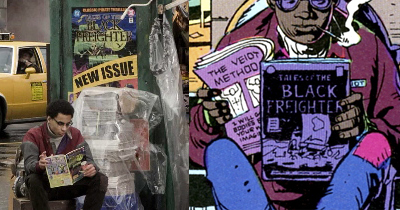 It's also interesting to note that he's leaning against a fire hydrant instead of an electric car recharging station. Why? More on that later. They've also crammed a lot of other locations from the book onto the same block. For instance, the Rumrunner Bar, next to which the ill-fated Moloch lives:
 Also, the Burlesk strip club, complete with the "Enola Gay and the Little Boys" marquee:
 And lastly, a poster for the aforementioned Pale Horse/Krystalnacht show hangs in the background:
Photo 2: Gunga Diner

 On the opposite corner from the newsstand (at least in the book), the Gunga Diner stands. They've maintained the shape of the window trim and the elephant logo, but sexed it all up a bit to good effect. There also appears to be a curtained greenscreen off to the left, which *ehem* wasn't in the book. Notice the difference in the taxi designs. The comic is based in an alternate 1980s where the influence of Dr. Manhattan has fast-forwarded us into new technologies like the electric car, among other things. The movie appears to be set in a non-alternate 80s, with normal cars and therefore, as I mentioned above, no charging stations. What does this mean? Is the Dr. Manhattan character's influence on the world downplayed in the movie? This was a major theme in the book, I wonder what they're cookin'.
Photo 3: Treasure Island

 Nothing really happens here at Treasure Island, aside from it being the earliest chronological appearance of the "Who Watches the Watchmen?" graffiti. They've added some details about what's on sale, and oddly used the chiefly British spelling of "collectibles." I guess that's what you get when you hire Canadian art directors.
Photo 4: The Pawn Shop?
 Hurm. Couldn't find any pawn shops in the book, but I did find a (much smaller) Nixon four more years poster:
 Which brings up an interesting point. Dave Gibbons' illustrations for the comic were extremely dense with little artifacts from the world of the book. But these artifacts were always subtle, never drawing attention to themselves. Notice that I couldn't find a better image of the Rumrunner sign, the Burlesk sign, or the Gunga Diner. These things are all throughout the book, yet they are easy to overlook because they don't announce their presence. We don't even ever see the full phrase "Who Watches the Watchmen?" We have to piece it together from the fragments we see throughout the story. This is what makes rereading Watchmen such a treat--you'll always notice something you never saw before. Here's hoping Zack Snyder is approaching the film with the same delicate touch.
All in all, these stills get me excited. They feel like Watchmen. Notice how faithful they're being to the slightly bizarre yellow and purple-heavy color scheme of the book: the yellows of the door Rorschach is walking towards and Treasure Island, and the purple Gunga Diner. Vrrr nice.


